Slow Down, Already: What the Malaysian 'Santai' Way of Life Can Teach Burnt-Out Americans
Let's be honest: Americans are exhausted. We wear our busyness like a badge of honor, stack our calendars like Jenga towers, and feel vaguely guilty the moment we sit still for too long. Somewhere between the 5 a.m. cold plunges and the productivity podcasts, we forgot that rest is not the enemy of ambition.
Malaysians, on the other hand, have a word for the art of taking it easy — and they've been living by it for generations.
Santai.
Pronounced san-tai, the word loosely translates to "relaxed," "easygoing," or "chilling out" — but that translation barely scratches the surface. Santai isn't just a mood. It's a posture toward life. It's the old uncle who takes forty-five minutes to finish one cup of teh tarik because he's too busy laughing with his neighbors. It's the Saturday afternoon that melts into evening without anyone checking their phone. It's the unspoken agreement that human beings are not productivity machines.
And right now, with burnout rates at record highs across the US, santai might be the philosophy we didn't know we were desperately searching for.
What Santai Actually Means (And What It Doesn't)
Here's where people get it wrong: santai is not about being careless or unambitious. It's not an excuse to ghost your deadlines or stop showing up. Malaysian culture is deeply community-oriented and hardworking — ask anyone who's watched their Malaysian parents or grandparents build entire lives from scratch in a new country.
Santai is about how you move through life, not whether you move at all.
"People always assume that because Malaysians are more relaxed, we don't care about success," says Farah Zulkifli, a graphic designer based in Austin, Texas, who grew up in Kuala Lumpur before moving to the US for college. "But my dad worked incredibly hard his whole life. He just never let work consume his identity. After dinner, he was done. He'd sit on the porch, drink his coffee, watch the neighborhood go by. That was sacred time."
That boundary — between effort and rest, between striving and simply being — is at the core of the santai philosophy. You work, you give it your best, and then you genuinely stop. No checking emails at 10 p.m. No replying to Slack messages during family dinner. No apologizing for taking a full lunch break.
The Kopitiam as Classroom
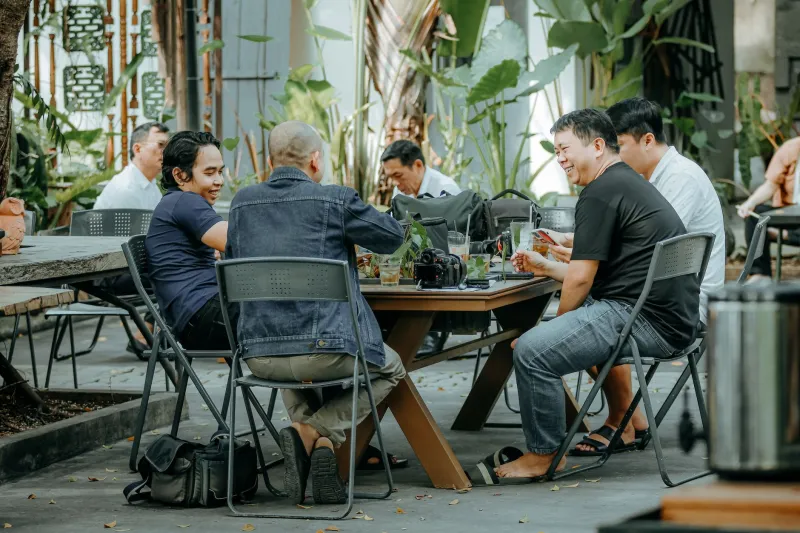
If you want to understand santai, start with the Malaysian kopitiam — the traditional coffee shop that functions as a kind of living room for entire neighborhoods. These aren't grab-and-go spots. They're places where time moves differently.
You sit. You order your kopi-o or your teh ais. Maybe you eat some toast with kaya butter. And then you just... exist for a while. You talk to whoever's sitting nearby. You watch the street. You let your thoughts wander without immediately reaching for your phone to fill the silence.
"The kopitiam was where my family solved problems, celebrated small things, and sometimes did nothing at all," recalls Daniel Tan, a software engineer in Seattle whose family emigrated from Penang. "When I moved here, I noticed that Americans seem almost uncomfortable with unstructured time. Like they need every moment to have a purpose. Back home, sitting together without an agenda was the purpose."
For Daniel, recreating that energy in Seattle meant carving out Sunday mornings as a no-agenda zone — no errands, no screens, just slow coffee and conversation with his wife and their two kids. "It felt strange at first. I kept thinking I should be doing something. But after a few weeks, it became the thing I looked forward to most."
Santai in an American Context: Real Strategies That Actually Work
Adopting santai doesn't require a flight to Kuala Lumpur or a total personality overhaul. It's about small, intentional shifts that add up over time.
Protect your after-hours time like it's a meeting. Malaysians have long understood that the evening belongs to family and rest. Try treating your post-work hours with the same firmness you'd apply to a work commitment. It's not "free time" — it's your time.
Eat without multitasking. In Malaysia, meals are events, not fuel stops. Even a simple lunch is a reason to sit down, be present, and actually taste your food. Eating at your desk while answering emails is essentially the opposite of santai.
Embrace the "lepak" mindset on weekends. Lepak — another beloved Malaysian concept — means hanging out with zero agenda. Resist the urge to optimize your Saturday. Sometimes the most restorative thing you can do is nothing in particular, with people you love.
Stop glorifying busy. When someone asks how you're doing, try resisting the reflex to say "busy!" as if it's a compliment. Santai culture values balance, and that starts with how we talk about our lives.
Ambition and Ease Are Not Enemies
Farah puts it simply: "I'm just as driven as my American colleagues. I just don't think suffering is proof of dedication."
That reframe is quietly radical in a culture that often conflates overwork with virtue. The Malaysian-Americans we spoke to aren't less successful for embracing santai — if anything, the boundaries they've maintained have made them more creative, more present, and frankly, more pleasant to be around.
Santai doesn't ask you to give up your goals. It asks you to stop treating rest as something you have to earn. It asks you to trust that a life well-lived includes long evenings, unhurried meals, and afternoons that drift by without a single item checked off a to-do list.
In a country that's slowly waking up to the cost of chronic overwork, that sounds less like a foreign philosophy and a lot more like common sense.
Maybe it's time we all pulled up a chair at the kopitiam — even if that kopitiam is just your kitchen table on a Tuesday evening, with nowhere to be and nothing to prove.