Wax, Dye, and Heritage: Why Malaysian Batik Is the DIY Craft Americans Didn't Know They Needed
Walk through any weekend craft fair in cities like Austin, Portland, or Brooklyn these days and you'll spot something unexpected tucked between the macramé and the hand-poured candles: bolts of richly patterned fabric, swirling with color and geometric detail that feels both ancient and impossibly fresh. Batik — a textile art with deep roots in Malaysian culture — has quietly made its way into the American DIY scene, and honestly? It's about time.
But batik isn't just a pretty pattern. For Malaysians, it carries centuries of identity, community, and artistry. Before you pick up a tjanting tool, it's worth understanding what you're actually holding in your hands.
A Craft Born from Culture
Batik's origins in the Malay Peninsula stretch back roughly 500 years, though some historians trace its broader regional roots even further. The word itself is believed to derive from the Javanese amba (to write) and titik (dot or point) — and that etymology tells you everything. Batik is, at its heart, a form of writing. A language in cloth.
In Malaysia, batik evolved into something distinctly its own. Malaysian batik — particularly batik pelangi (rainbow batik) and batik lukis (hand-drawn batik) — tends to favor larger, bolder floral and nature-inspired motifs compared to its Javanese counterpart. The craft became deeply embedded in Malaysian identity, particularly in the east coast states of Kelantan and Terengganu, where master artisans passed techniques down through generations.
Today, Malaysian batik isn't just a cultural artifact — it's a living tradition. You'll find it in high-end fashion collections, in the official shirts worn at ASEAN summits, and on the backs of everyday Malaysians heading to a family kenduri (feast). When Malaysian-Americans dress their children in batik for Hari Raya or Hari Merdeka celebrations here in the US, they're not just wearing fabric. They're wearing a story.
How Batik Is Made: The Magic of Wax and Dye
The basic principle of batik is a resist-dyeing technique — you apply wax to fabric in specific areas, then dye the cloth. The wax resists the dye, creating patterns. Simple in concept, endlessly complex in execution.
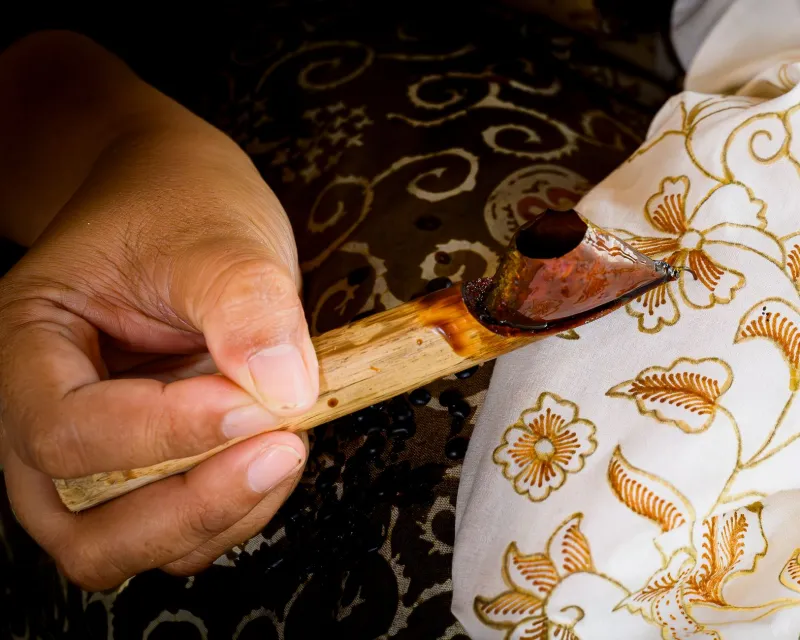
Traditional Malaysian artisans use a canting (pronounced "chanting") — a small copper cup attached to a wooden handle — to draw hot wax onto fabric in intricate freehand designs. Others use copper stamps called cap for repeating patterns. The fabric is then dipped in dye baths, the wax is removed (usually by boiling), and the pattern is revealed.
What makes Malaysian batik particularly beautiful is the crackle effect — those fine web-like lines that appear when wax cracks slightly during the dyeing process. Far from being a flaw, Malaysian batik makers often embrace this as part of the charm.
Why Americans Are Falling for It
In an era of fast fashion and algorithmically generated home décor, there's a growing hunger for things that mean something. Batik scratches that itch in a profound way. Every piece you make is genuinely one of a kind. The process is meditative — it demands your full attention in a way that's almost therapeutic. And the result is something you can wear, hang, or gift that carries real cultural weight.
The craft also fits neatly into the broader DIY and slow-living movements that have exploded in American culture over the past decade. If you're someone who bakes sourdough from scratch or spends weekends at a pottery studio, batik might just be your next obsession.
Try It Yourself: A Beginner's Guide to Batik at Home
You don't need a studio or a trip to Kuala Lumpur to get started. Here's a simple approach to making your first batik piece with supplies you can find at most craft stores or online.
What you'll need:
- 100% cotton fabric (pre-washed and ironed flat)
- Batik wax or a soy wax alternative (easier to clean up)
- A small electric wax pot or a double boiler
- A tjanting tool or small paintbrush for wax application
- Fiber reactive dyes in your chosen colors (Procion MX dyes are widely available)
- Rubber gloves, a plastic tub, and soda ash for the dye process
- An old pot for wax removal
Step 1: Sketch your design. Lightly pencil a simple floral or geometric pattern onto your fabric. Malaysian motifs often feature hibiscus flowers (Malaysia's national flower), leaves, and flowing curved lines — great inspiration for beginners.
Step 2: Apply the wax. Heat your wax until it's fully liquid and flows easily. Using your tjanting or brush, carefully trace over your penciled design. Work quickly — wax cools fast. You should be able to see the wax penetrate through to the back of the fabric. If it looks opaque and white on top, your wax isn't hot enough.
Step 3: Dye your fabric. Mix your dye according to package instructions with water and soda ash. Submerge your waxed fabric and let it soak for the recommended time. For a traditional Malaysian look, start with a lighter base color, then re-wax and dye again with a deeper shade to build layers.
Step 4: Remove the wax. Once your fabric is dry, remove the wax by boiling the fabric in a large pot of water. The wax will float to the surface. You may need to repeat this step once or twice for full removal. Alternatively, sandwich the fabric between newspaper sheets and press with a warm iron — the paper absorbs the wax.
Step 5: Rinse and reveal. Rinse your finished piece in cold water, hang it to dry, and prepare to be genuinely amazed at yourself.
More Than a Hobby
Here's what makes batik different from most craft trends: when you make it, you're participating in something that generations of Malaysian families have considered sacred enough to preserve and protect. Malaysian batik received UNESCO recognition as part of Malaysia's intangible cultural heritage, and Malaysian artisans have spent lifetimes perfecting what you're learning in an afternoon.
That's not a reason to stay away — it's a reason to approach it with curiosity and respect. Learn about the tradition. Seek out Malaysian batik artists on social media and support their work. If you're in a city with a Malaysian community, ask around — you might find a local artisan willing to teach a proper workshop.
And if your first attempt looks more abstract than traditional? That's okay. Art has always crossed borders and evolved in new hands. The wax is still warm, and the story is still yours to tell.