Keep It Close: What Malaysian Families Know About Privacy That the Rest of Us Have Forgotten
Scroll through your feed on any given Tuesday and you'll find someone's messy divorce playing out in real time, a family feud dissected in a Twitter thread, or a teenager's most humiliating moment immortalized in a TikTok their parent posted without a second thought. Oversharing has become so normalized in American culture that choosing not to share feels almost suspicious — like you're hiding something.
But for many Malaysian-American families, not broadcasting every moment of their lives isn't hiding anything. It's just how things are done. And increasingly, people outside that tradition are starting to wonder if they've been missing something important.
There's a Word for It
In Malaysian culture, the concept of maruah — loosely translated as dignity, honor, or self-respect — quietly governs a lot of decisions that might otherwise seem like simple personal preference. What you share, who you share it with, and when you speak versus when you stay quiet are all filtered through this lens.
It's not about shame, exactly. It's more like a deep, collective understanding that some things belong to the family, not the internet.
"Growing up, there were just things you didn't talk about outside the house," says Nadia, a Malaysian-American in her early thirties who lives in Houston. "Not because they were shameful, but because they were ours. My parents' disagreements, our financial stress during hard times, my grandmother's health — those weren't stories to tell. They were things we held together."
This instinct is woven into the fabric of how many Malaysian families operate, shaped by layers of cultural influence — Malay, Chinese, Indian, and Indigenous traditions that, despite their differences, share a common thread of communal discretion.
The Quiet Ones in the Room
If you've spent time around Malaysian-American families, you might have noticed something. At gatherings, they laugh loud and feed you until you physically cannot eat another bite. But ask a probing personal question — about money, marriage trouble, a kid who's struggling — and you'll often get a warm smile and a graceful pivot. Not rudeness. Just redirection.
This isn't evasion for its own sake. It reflects a cultural understanding that your private life is something you protect, not perform.
"I think Americans sometimes mistake our privacy for coldness," says Farouk, a Malaysian-born father of three who moved to the Pacific Northwest fifteen years ago. "But it's the opposite. We share deeply — just with the right people, at the right time. Not with everyone, all the time."
He pauses. "My daughter once asked me why her friends' parents post everything on Instagram. I told her: some things are too precious to give away for free."
When Two Cultures Collide
For Malaysian-American kids growing up in the US, this can create real tension. American social culture — especially among teenagers and young adults — runs on visibility. Sharing is bonding. Vulnerability performed publicly is often rewarded with likes, followers, and a sense of community.
When your family's default setting is discretion, navigating that landscape gets complicated.
"In college, I felt so behind," admits Priya, whose parents emigrated from Malaysia to California before she was born. "Everyone was being so open about their mental health, their relationships, their family drama. And I just... couldn't. It felt wrong to me in a way I couldn't explain."
It took her a while to realize that what felt like a limitation was actually a set of values she'd quietly inherited. "I started to see that I wasn't broken for not wanting to share everything. I just had a different relationship with privacy. And honestly? I think my relationship with my inner circle is deeper because of it."
That selectivity — sharing meaningfully with a few rather than broadly with many — is something mental health professionals have been nudging Americans toward for years. The irony is that a lot of us are still struggling to get there, while some families have been living it all along.
What Gets Protected (And Why)
So what kinds of things do Malaysian families tend to keep close? Conversations with Malaysian-Americans across the country reveal some consistent themes.
Family conflict is almost universally considered private. Arguments, estrangements, disagreements between spouses or siblings — these are handled internally, not aired publicly. The idea of posting a subtweet about your mother-in-law or venting about your husband's shortcomings to an audience of strangers would strike most Malaysian families as a profound breach of loyalty.
Financial matters are similarly guarded. Whether things are going well or going badly, money talk stays in-house. This isn't about pretending everything is fine — it's about maintaining a boundary between the family unit and the outside world.
Children's struggles also tend to be protected fiercely. Where American parenting culture has developed an entire genre of content around documenting kids' failures, tantrums, and awkward phases for public consumption, many Malaysian-American parents find that instinct genuinely baffling.
"My kids' hard moments are not content," says Suraya, a mother of two in the Chicago suburbs. "When my son was having trouble at school, that was between us, his teachers, and God. Not Facebook."
Not Repression — Intention
It's worth being clear about what this isn't. Malaysian cultural discretion is not about suppressing emotion, pretending problems don't exist, or suffering in silence. Plenty of Malaysian families are wonderfully expressive, deeply communicative, and emotionally open — within their trusted circles.
The distinction is intentionality. Choosing who deserves access to your vulnerability. Deciding what genuinely needs to be shared versus what you're sharing out of habit, boredom, or the hunger for validation.
"There's a difference between being authentic and being an open book for everyone," says Nadia. "I can be fully myself without letting the whole world in."
In an era where the pressure to perform your life online is relentless — where silence gets misread as having nothing interesting to say — that kind of quiet confidence is genuinely countercultural.
The Takeaway Most of Us Could Use
You don't have to be Malaysian to borrow a page from this particular playbook. The idea that some experiences are made more meaningful by not broadcasting them, that intimacy lives in the spaces between what you share and what you protect — that's wisdom that transcends culture.
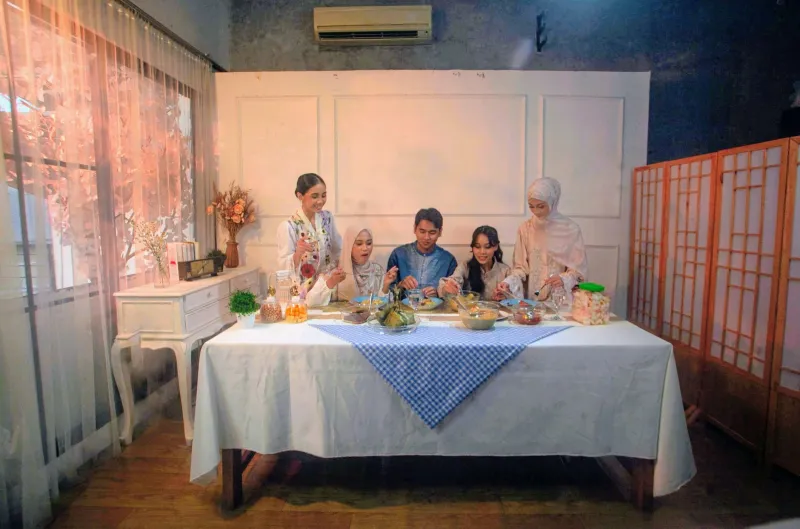
Maybe the family dinner doesn't need to be on Instagram Stories. Maybe your marriage's rough patch belongs to you and your partner, not your followers. Maybe your kid's first heartbreak is something they'll thank you for keeping private someday.
Keeping things close isn't a failure of openness. Sometimes, it's the deepest form of care.
And for Malaysian families who've been doing it quietly all along — well, the rest of us are just now catching up.